Showing posts with label Golden Gate Avenue. Show all posts

Thursday, October 6, 2011

It's Gone At Last: Lyon Street Eyesore Removed after 3+ Years


The NE corner of Lyon and Golden Gate hasn't been clear like this for a very long time

Just after the morning downpour, the scaffolding was dismantled

New and nearly completed emergency exits on Golden Gate side of building

All this structure for a fire escape the last three years

At the end of the day it was simple: remove the ungainly, ill-suited scaffolding eyesore and replace it with standard regulation fire escapes. For NOPA neighbors it was the blight that wouldn't go away. Until today. Now at last the Lyon and Golden Gate corner is clear of the obstruction. The sidewalk is safer for pedestrians, two spaces are open for street parking, and, most importantly, the apartment building residents have a safer exit from the building should a fire strike.

BIKE NOPA has been covering this story for more than a year, beginning with a post in January of 2010. Three more followed to urge a resolution and mobilize neighbors who had really had enough of what came to represent frustrations with the city's permit approval process and, apparently, reluctance of the owner to foot the bill and do the right thing.

Sometimes a more livable street comes about from what's removed, not what's added. Time for a celebration all around.

Friday, April 22, 2011

North Panhandle Eyesore on Track for Removal; Work Set for New Fire Escapes


Scaffolding serving as fire escape on Lyon street at Golden Gate
After years of wanting the ugly structure to come down, North Panhandle residents are likely wary about any news that the four-story scaffolding sidling the apartment building on Lyon at Golden Gate may actually be seeing its final weeks. But that appears to be the case. Pat Buscovich, a developer working with the owner of the apartment building, told BIKE NOPA that the process to replace the structure with a real fire escape is underway.
"Once we get the go-ahead, it will take six weeks or more to fabricate suitable fire escapes. We have a manufacturer lined up and ready to start. During that time we will prepare the building so it will be ready for the fire escape to be bolted to it. We will get the larger unit for the Golden Gate side of the building installed first. Then we'll be able to dismantle the scaffolding along Lyon one floor at a time as we put up the exits on that side."
Few manufacturers remain in the fire escape business, according to Buscovich. "The code for the equipment changed in 1995 and many steel fabricators stopped making them since then." The fire exits for the Lyon building are expected to cost $30,000 or more. Over the several years that the scaffolding has been occupying the 40 feet of curb space, the owner might easily have purchased the equipment for the cost of the rental fees.

Buscovich said contractors were at the site yesterday and had begun the preparation. His reading of the situation is that everyone wants to bring this long story of tenant/landlord conflicts and complications among city agencies to an end. "The owner wants it done, the residents want it to happen, and I'm sure the neighbors are ready to see this over with."

Although BIKE NOPA previously suggested the permit granted for ongoing work might be simply one more delay after several years of inaction, it now appears that the owner is ready to proceed and the city has signed off on the project. A building permit to do so is essential. We hope the next chapter in this story includes photos of the new fire-escapes and a scaffolding-free street.

Monday, August 2, 2010

NOPA 38% UNDERGROUND(ED)


First posted in August 2009 and republished now as NOPA residents take a closer look at our streets and public spaces.

Is your NOPA street undergrounded?
Undergrounded, as in the utility lines on your street have been buried and the utility poles and overhead wires are gone. If you live on a street without the wires and poles, you tend to take the clear, unentangled views for granted after a bit -- until you walk a block and see what streets look like with them.
Utility undergrounding is a good-times venture. When the economy thrives, the city can afford to be expansive in its beautification measures. In May (of 2009) the Board of Supervisors considered adding undergrounding to a streets repair bond measure. But the prospects for the added expense were not good, and the idea was dropped. In a few weeks, so was the bond measure. Telephone surveys among likely voters put a damper on the prospects at the polls.
The cost to underground one mile in the city is approximately $6.7 million in 2009 dollars, according to the Department of Public Works. Of San Francisco's 1278 roadway miles, 470 have been undergrounded to date.
How does NOPA fare with undergrounding? We're doing well enough, especially compared to many other neighborhoods. Of NOPA's 71 blocks*, 27 are already undegrounded. That's 38% of the total.
Which NOPA streets are clear of the poles and wires? All the perimeters: Fell, Masonic, Turk, and Divisadero. And one more street: Golden Gate. Anyone know why and when Golden Gate received the special treatment? Perhaps when it served as a feeder for Central Freeway traffic.
District Five has the second highest number of curb miles undergrounded in the city: 59% of its 67 miles. District 3 is at the top with 70%, while Districts 11 sits at only 1% and District 10 at 12%. There's a whopping big need for some geographic equity when the economy improves.

Thursday, May 13, 2010

#5 Fulton Riders & Bicyclists To Get Direct Access to Market Street from McAllister


#5 Fulton: one of NOPA's primary transit lines. Flickr Photo by Mike LaHood/SF Public Press

Amid the dire service cuts to all Muni lines and the threat of worsening conditions for the city's transit riders, there's at least one glimmer of positive news for Muni patrons who use the #5 Fulton bus. As first reported by Streetsblog, an MTA proposal to convert the two-and-a-half blocks of McAllister Street from Hyde to Market from one-way to two-way for transit, bicyclists, and deliveries was recommended for approval during an April 30 public hearing. If the change is accepted by the full MTA board as expected in June, the #5 and cyclists will no longer need to shuffle and shift through the Civic Center to reach Market. Private vehicles, however, will be prohibited from using the eastbound traffic lane on the these blocks. The traffic engineers' plan for McAllister was cleared for final MTA consideration at the same public hearing that also moved the Fell/Arco proposal to the board.

NOPA residents who use the #5 or the McAllister bike route to get downtown should find their rides a bit quicker. The news may be especially welcome to cyclists who prefer McAllister's gentler grade over Golden Gate Avenue's steep slalom ride from Broderick to Van Ness and then to Market.

Readers note: The most comprehensive and thoughtful coverage of everything related to the operations and current fiscal crisis at SFMTA with all the impacts on transit users can be found at sf.streetsblog. The year-old news blog has changed the Bay Area's understanding and discussion of transportation and livability concerns.

Friday, April 30, 2010

No Left Turn from Masonic to Golden Gate Clears Public Hearing


No left turn for southbound Masonic traffic onto Golden Gate under plan

Traffic calming measure for Masonic Avenue

A new restriction on left turns during morning and evening commutes from Masonic Avenue to Golden Gate Avenue moved one step closer to implementation Friday morning at a public hearing. The proposal by the MTA would restrict the turns from 7am to 9am and 4pm to 7pm except Saturday and Sunday. An MTA hearing officer approved the proposal after hearing two individuals testify in support of the measure and finding no one in opposition. The turn restriction will now be sent for final approval to the full MTA board where it is expected to pass.

Danny DeLeon, Facilities Manager for the San Francisco Day School, urged implementation of the plan to calm the traffic on Masonic Avenue. He cited several traffic collisions at the intersection, mostly the result of speeding downhill southbound traffic and accelerating uphill traffic that approaches Golden Gate. The Day School is situated at the northeast corner of Golden Gate and Masonic.

Marc Caswell, SFBC staffer, addressed the hearing as a Masonic Avenue resident and a member of the grassroots group FixMasonic. "This is a good addition to traffic calming on Masonic," Caswell said, "but we are hoping to see comprehensive changes in traffic design with other safety measures for the corridor." FixMasonic has long advocated an overhaul of the traffic flow patterns on Masonic to better share the roadway with diverse users and to vastly improve safety for all. Although MTA presented the turn restriction, the impetus behind the action was concern by members of the Day School. Leonard Moon, a parent of one of the students at the school, organized the request for the traffic change. Earlier this month Moon organized a kids-and-parents bicycle contingent as part of the citywide Bike to School Day celebration.

FixMasonic and other concerned neighbors are urging the MTA to imitiate the community review and study of redesigning Masonic which BIKE NOPA discussed earlier here. The agency received $120,000 more than a year ago to undertake the project.

The measure will go to the MTA board in June for final review.

Tuesday, April 20, 2010

No Left Turn on Golden Gate from Masonic During Commute Hours: MTA Proposes New Traffic Safety Measure


Restricted turns already at Masonic and Turk Streets

No Left Turn sign would be posted at this intersection

Left turns by northbound motorists on Masonic already restricted

The Municipal Transportation Agency hopes to reduce the number of collisions on Masonic Avenue by prohibiting left turns at Golden Gate Avenue for southbound traffic during morning and evening commutes. The intersection is particularly risky given the steep grade between Fulton and Turk Streets and the ongoing problem of speeding motorists. Southbound drivers wanting to turn left back-up traffic while trying to find an opening in the oncoming rush. And northbound motorists must negotiate the intersection with left-turners sometimes already beginning their turn. The proposed sign will advise NO LEFT TURN, 7-9 AM, 4-7 PM, except Sat & Sun. A similar restriction already exists for northbound traffic at Golden Gate, but it does not exempt Saturdays.

The traffic safety measure results from neighborhood concerns about safety hazards at the intersection, especially for students at the San Francisco Day School located on the northeast corner. Dr. David Jackson, Head of School, told BIKE NOPA last week that MTA reviewed the traffic situation after a collision in February in front of the school. A concerned neighbor requested that the city establish the new restriction. Jackson cited safety problems on Masonic and other streets as one reason more students don't bike to school.

Fix Masonic, the grassroots organization urging traffic calming on the corridor, was not advised of this proposal. That group is awaiting implementation of a thorough analysis of Masonic Avenue involving city engineers, planners, and nearby residents. MTA received $120,000 more than a year ago to undertake the study.

Nearby residents will be notified of the NO LEFT TURN proposal this week. A public hearing will be held Friday, April 30th at 10 a.m. at City Hall in Room 416. See the hearing schedule here.


Monday, February 22, 2010

NOPA's "Negative Spaces" Showcased in Light Installation: Artist to Reveal Hidden Features of Local Victorians


Photos by Tanu Sankalia of light installation test run last May

Golden Gate Avenue by a different light

Slots that define our neighborhood as much as the famous facades

"You Will Never See NOPA In The Same Way," according to a University of San Francisco press release announcing a unique art installation scheduled for later this week. Elaine Buckholtz, a Bay Area artist, will bring her vision and facility for revealing what is hidden in plain sight to Golden Gate Avenue in NOPA on Thursday and Friday evenings, February 25 and 26. Once the sky darkens the street, Buckholtz will shift viewers' gaze from the familiar facades to the seldom noticed spaces, "the slots," between the elegant structures. The buildings are located on the north side of the street between Lyon and Baker at 1906 to 1914 Golden Gate.

From 5:30 to 8 pm on both evenings, the "light-sculpted interstitial space" between the Victorians will be revealed. The staging will "foreground" the "geometry of negative space, revealing forms that are unnoticed by day." Buckholtz describes these largely unappreciated areas hedged between Victorians as "the smallest discernable spatial units of the city" that are repeated along rows of the Victorians on North Panhandle streets. She asserts that "the repetition of these spaces ... produces a pattern that is equally as intrinsic and unique to this neighborhood's urban form as the Victorians themselves."

As a light designer and installation artist, Buckholtz has distinguished herself with work throughout Europe and the Bay Area. She currently teaches at Stanford University. The University of San Francisco is sponsoring the light installation in coordination with the institution's Thacher Gallery. The on-the-street exhibit complements the on-campus show, "The Urban Unseen: Examining San Francisco's Interstitial Spaces," free and open to the public from February 21 to April 25 in the Gleeson Library/Geschke Center, 2130 Fulton Street at Parker Street. Tanu Sankalia conceptualized and curated the exhibition. An artist panel and reception are scheduled for Thursday, February 25 at the university. "All Over Coffee" artist Paul Madonna will also present his architecturally detailed work. Information here and at (415) 422-5178, www.usfca.edu/library/thacher. A special thanks to NOPA neighbor Purvi Sahu for alerting BIKE NOPA to this special neighborhood event.


Friday, February 5, 2010

"Better illegal and safe than legal and dead": Masonic Avenue sidewalk cyclist


Travelling up Masonic

In front of the San Francisco Day School


Bicyclists who ride on Masonic Avenue sidewalks do so as a last resort, according to several who posted comments following yesterday's BIKE NOPA story about riding on sidewalks in the city. A study conducted by the San Francisco Municipal Transportation Agency found that 30% of cyclists (13 of 43) passing through the Masonic and Golden Gate Avenue intersection rode on the sidewalk. The percentage made the NOPA intersection the second highest of the three dozen sites included in the study. The bike count was undertaken on an August day last year between 5pm and 6:30 pm.

"Masonic is the only street in the city which I regularly ride on the sidewalk - and only in the uphill direction. Riding in the street there is some of the worst in the entire city -- and the sidewalk is plenty wide to acomodate bikes and pedestrians." mfogel

"I'm part of the better illegal and safe than legal and dead sidewalk riding crowd. I've been riding in the City for over 20 years and for the past few years I've switched to the sidewalk on Masonic heading uphill to Geary. I had too many scary encounters to ride in the street." Cheryl

"I think this street corridor is one of the biggest problems city-wide." Philip Peter

"I commute on Masonic daily and it's still treacherous. The cars get the light on Turk and keep their momentum going past the 25 mph sign hidden by the trees. On Monday morning when the parked cars are cleared, it's even faster. The Allowed Full Use of Lane sign is placed at O'Farrell after the damage is done. It's also way above sight level. I hate taking the sidewalk there which is uneven and terrible to ride on, but I do, only place in the city I do." James Farinacci

Although the SFMTA study counted bicyclists at the intersection of both Masonic and Golden Gate Avenue, there's little doubt that the incidence of sidewalk bicycling occurs almost exclusively on Masonic since Golden Gate is flat, smooth, and has a striped bike lane.

On the northeast corner of the intersection is the San Francisco Day School, and children, parents, and staff frequently use the sidewalks and crosswalks. But one of the teachers at the school has no problem with the sidewalk cycling.

"I teach at that corner. I've never seen a bicyclist riding carelessly on the sidewalks of Masonic. ... Almost all cyclists who use the sidewalk are going uphill which is slow work. I've also never seen a pedestrian get upset with such a bicyclist, because it's so obvious to everyone that riding on the street would be really scary." Diane

Fix Masonic, the neighborhood group that has advocated for safety measures on the corridor for years, continues to urge the SFMTA to use available, dedicated funds to assess neighborhood sentiment about a re-design of Masonic. A few of the BIKE NOPA readers have already expressed theirs.

Riding on the sidewalk: "that's not a good solution, compared to removing a traffic or parking lane, and putting in some real (painted GREEN!) bike space." mfogel

"It would be nice to have a physically separated, bi-directional bike lane on the east side of the street that connects logically from the Panhandle, through the weird overpass business to Laurel/Presidio Heights." Philip Peter


Thursday, February 4, 2010

Masonic Ave: Sidewalk Riding for Safety


Safer than biking on the street at Masonic and Golden Gate

Illegal biking or safe use of a wide sidewalk along a dangerous street?

Not much bike space on northbound Masonic Avenue

No better on southbound Masonic either

Golden Gate Avenue at Masonic Avenue registered the second highest percentage of bicyclists riding on the sidewalk during the 2009 Bicycle Count conducted by the San Francisco Municipal Transportation Agency (SFMTA). During the evening traffic rush (5 pm to 6:30 pm) on an August workday, 30% of cyclists (13 of 43) rode on the sidewalk.

The SFMTA study also notes that Golden Gate and Masonic are both signed bike routes with bike lanes. But that’s only partly right. Golden Gate has a striped bike lane; Masonic does not. Golden Gate’s bike lanes, at least between Parker and Divisadero, are what cyclists in other parts of the city work for: they’re wide enough on smooth surfaces.

Masonic is a different story. There’s no bike lane, no sharrows, and little space to “share the road” with motorists. The three block stretch between Turk and Fulton Streets has steep inclines, and drivers regularly race up the hill northbound or rush down southbound to make the lights. The posted 25 mph speed limit appears to have had negligible impact since the neighborhood group FIX MASONIC pushed to get it dropped from 30 mph. In fact, the current design of Masonic offers next to nothing to cyclists, except for the posted bike route signs.

The SFMTA study does not indicate the direction cyclists were traveling, but it’s safe to assume that Masonic sidewalks are the ones that get the peddlers. “The bicyclists are trying to be safe,” a school crossing guard observed yesterday afternoon while helping pedestrians cross Masonic and Golden Gate. “Masonic has very little space for cyclists, especially north of here.” In the ten minutes I observed traffic at the intersection at 3:30 pm, four cyclists rode along the Masonic sidewalk at the intersection.

Why do bicyclists ride Masonic – either the street or the sidewalks -- and take the risk on the street or breaking the law on the sidewalk? For the same reason that motorists drive Masonic: it’s the primary north-south route through this part of town, especially for travel between the Fell-Oak corridor and Geary Boulevard. The Anza Vista neighborhood breaks up the usual street grid, as does the Panhandle Park.

The San Francisco Day School is located at the northeast corner of this intersection with one of its entrances on Masonic. The bicyclists riding the sidewalk in front of the school pose at least a theoretical threat to the school kids, staff, and neighbors walking nearby, especially if the cyclists indulge in reckless, erratic riding. But a careful biker riding slowly and cautiously poses little problem given the larger-than-usual width of the sidewalk.

Bicycle riding on sidewalks is illegal for adults in San Francisco. But then, bike riding on through-streets that the city designates as bike routes but fails to make safe for cyclists is unwise for most peddlers. The SFMTA weighs in on the issue of sidewalk biking at this and other locations. According to the report, “SFMTA will continue to monitor sidewalk and wrong-way riding, as well as work to implement additional bicycle safety and education campaigns on these two behaviors.” One might wish for something a bit more bracing and innovative like traffic and street designs that serve all users of Masonic Avenue.


Thursday, January 14, 2010

Street Eyesore Takes Up Residency in NOPA


Public street space claimed by private fire escape on Lyon at Golden Gate

"a blight on the neighborhood"

There are few simple stories in San Francisco, and the saga of the over-sized fire escape on Lyon Street near Golden Gate is one that isn't. But it does offer up the usual suspects of conflict: landlord/tenant relations, land use arguments, the city permit process, and 50 years or more of creative, non-code building practices.

The three-story metal structure has sidled along the turn-of-the 19th century apartment building since last summer. It provides an emergency exit for a few residents, but passers-by might wonder, "Why not just install a regular flat-against-the-exterior fire escape?" Indeed, why not? Instead this metallic behemoth disrupts sidewalk use, displaces 4-5 parking spaces, and offends neighbors who can't help but notice it.

The emergency structure was installed as a compromise, the result of a quirky arrangement decades ago for the adjacent properties on the northeast corner of Golden Gate and Lyon. A previous owner built a wooden fire escape from a unit in the Lyon building onto the roof of the Golden Gate building and then into that property's back yard. A wooden fire escape: there's a problem. Onto the roof of the adjacent house: seems like another. This unorthodox and dangerous set of circumstances remained until four years ago when a city housing inspector wrote up the building for code infractions and an illegal housing unit. The city's Board of Permit Appeals apparently saw things differently and ruled the unit in question was legal, but both bodies agreed the old wooden fire escape had to go. No one agreed, however, about where a standard, up-to-code substitute should be installed. The compromise reached among the city groups and the owner and contractor is the ungainly scaffolding hogging street space on Lyon today. No one is pleased with the outcome, including the owner of the Lyon Street building, according to his attorney, Andrew Zacks. "The owner understands this is a blight on the neighborhood," Zacks told BIKE NOPA.

Now this post began with a simple inquiry to the responsible construction firm about when this "blight" would be removed. (The current notice, posted on the scaffolding, lists February 27, 2010 as the end of the permit period). I never intended to conduct an investigation of one more example of the seemingly arcane routes of building code administration in the city. I simply hoped to find that the safety of the tenants would be assured with access to standard fire escapes and that the neighborhood would be spared the ugly, overbuilt scaffolding.

Patrick Buscovich, owner of Patrick Buscovich & Associates Structural Engineers, told BIKE NOPA that a safe and more attractive solution may be near at hand. "One standard fire escape will be installed on the Golden Gate side of the building with another, separate escape on the Lyon Street side for one "land-locked" apartment," he explained. Everyone seems to agree with this outcome: the owner, the Fire Department, the Planning Department, and, perhaps, the tenants. Buscovich thought he would receive a permit for one of the structures in two weeks, with the other to follow. Realistically though, NOPA neighbors might expect a few more months to pass before this formidable building from 1899 stands free of its unsightly accompaniment.

Tuesday, January 5, 2010

NOPA's Greenest, Most Sustainable Building With Its Cool Permeable Sidewalks


Zygmunt Arendt House

Golden Gate Avenue side with permeable landscaping and recycled granite

Broderick Street side, close-up, ready for landscaping

NOPA starts the New Year with the imminent opening of its newest and largest development and a first in the neighborhood to apply extensive green construction principles. The Zygmunt Arendt House is a 47 unit affordable housing project at 850 Broderick that anchors the intersection with Golden Gate and extends downhill nearly half way. Although the price tag for the privately-funded development is high at more than $16 million, the building exterior pleasantly recalls the nearby Victorian and Edwardian architecture and promises to enliven a long dormant corner of the neighborhood. Construction began more than a year ago and is expected to be completed early in 2010. The building features several sustainable, “green” enhancements including:

· An energy-efficient structure, or “envelope,” and mechanical systems

· Photo-voltaic rooftop panels

· Planter boxers and open sidewalk areas that retain storm water runoff

The Arent House benefits from the environmental standards set by the city in 2005 for new low-income housing. The green construction elements will establish the Arent House as the most sustainable and “greenest” building in NOPA.

Before focusing on one sustainable aspect of NOPA’s newest residential project – the impressive commitment to “permeable sidewalks” – let’s take a look at who our newest neighbors will be. The Zygmunt Arendt House will serve formerly homeless elders, providing them with on-site support services and skills training. The undertaking is a joint development project of the Community Housing Partnership (CHP) and the Tenderloin Neighborhood Development Corporation. CHP is a San Francisco-based non-profit with a clear focus on creating and implementing “solutions to homelessness,” and the organization has set ambitious goals for the Arent House:

  • Ensure that 97% of clients retain permanent housing
  • Help 75% of residents seeking jobs to find work
  • Develop staff so 50% are former homeless people

Project staff is committed to being good North Panhandle neighbors as well. Several members introduced themselves and briefly described their work at last November’s meeting of the North of the Panhandle Neighborhood Association (NOPNA).

Stop by the construction site of the Arendt House now to watch the installation of NOPA’s largest expanse of concrete-free, permeable sidewalks. These cut-out areas along the Broderick and Grove sides of the building drain stormwater run-off and reduce the burden on San Francisco’s water treatment plants. They also create much-needed open spaces for trees and plants along our streets and sidewalks. Even covering the concrete-free spaces with loose stones or other natural or man-made materials opens the soil to air and water.

Other than the skinny sidewalks of Divisadero Street, NOPA is fortunate to have many broad pedestrian stretches especially along its north-south streets. Most of these could easily accommodate their own permeable segments, perhaps as extensions to existing cut-outs for new and existing street trees. Find out how to green your sidewalk at PlantSF and look for future BIKE NOPA posts on permeable sidewalks.

Friday, January 1, 2010

A NOPA Wish for 2010


Thanks to our Golden Gate neighbors.


Tuesday, December 22, 2009

SFBC Reports, Gets Repaired NOPA Sinkhole

Emerging sinkhole on Golden Gate between Masonic and Central

17th & Dolores Streets,
before the patch paving of crosswalk

What started as a smooth but deep dip in the pavement along Golden Gate Avenue became a crumbling crevice and a real hazard to pedestrians, bicyclists, and motorists earlier this month. Fortunately, the San Francisco Bicycle Coalition's (SFBC) Good Roads volunteers were spinning through NOPA on their first-Saturday-of-the-month ride December 5th. The group of eight stopped, circled the emerging sinkhole with white spray paint to alert others of the defect, noted the nearby address, and later reported it to 311. Within days, a work crew from the Department of Public Works (DPW) repaired the hole and smoothed the surface. The "pothole intervention" is one way that SFBC and bicycle advocates work to improve city streets for all users.

In operation for nearly two years, the Good Roads campaign has turned in more than 1500 potholes, cracks, and sunken manholes found on city streets, especially along bike routes. The SFBC has developed a good working relationship with DPW, and together they manage to make much of the city's bike network safer and smoother for cyclists. While many streets in the city require complete resurfacing for safe use by cyclists and motorists, the pothole repairs take care of immediate problems.

Neal Patel, SFBC Community Planner, notes that Good Roads volunteers help the city do what it lacks the manpower for -- being "eyes on the street" to identify pavement problems needing repair. "We bring a small group of people together to identify a large number of hazards in a short period of time in one geographic area," Patel said.

The Good Roads Campaign benefits more than bicyclists. During their monthly excursions, the riders also report damaged crosswalks, missing utility covers in the streets and sidewalks, and gaping holes in lanes of traffic. For example, the SFBC volunteers requested advanced re-paving for two blocks of 17th near Potrero due to excessive pavement cracking, wide patch-paving for the Dolores Street crosswalk at 17th Street in the Mission, and replacement of missing manhole covers on Palou Avenue in the Bayview.

The Good Roads Ride is open to bicyclists who want to make San Francisco safer for everyone. Volunteers visit a different neighborhood every ride, and first-timers are always welcome. Check the SFBC Good Roads site or contact neal@sfbike.org for more information. The next ride is Saturday, Jan. 9th -- delaying by a week the usual first Saturday ride for those recovering from the holidays.

Saturday, December 19, 2009

It's Official: Sunday Streets Coming to NOPA


great graphic from Livablecity.org

photo by Michael Helquist

Sunday Streets @ San Francisco by slowpoke_sf.
photo by slowpoke_sf on Flickr

photo by steverhodes on Flickr

The buoyant, smile-inducing, bike spinning, pedestrian-safe celebration known as Sunday Streets will course through NOPA in 2010. Fine-tuning of the new Western Addition route is underway, but the blocks expected to involve NOPA include Central Avenue, Grove Street, Baker Street, and Golden Gate Avenue. Mayor Gavin Newsom announced today the dates and neighborhood locations for nine Sundays from March through October next year. NOPA's chance to host part of the route will come on September 19th, when the city is most assured of sunny, warm weather.

Next year's Western Addition/Alamo Square/NOPA route will be the first foray into mostly residential neighborhoods for Sunday Streets. Cheryl Brinkman, president of the board of Livable City, noted how successful Sunday Streets was this year in the Mission's commercial area. She added, "We hope with NOPA and the Western Addition to have the same success with a primarily residential route. It's a great opportunity to give residents a respite from car traffic on their streets and see what they make of it."

Kevin Rafter, President of the North Panhandle Neighborhood Association, thinks the event is right on target. "NOPNA is always eager to support events that build community and get more neighbors out on the streets. We know that so many of our neighbors bike to school, work, and in-between so this event makes a lot of sense to us. We're eager to make this event a success in NoPa."

At the same time, NOPA's merchants can expect a big boost in business from Sunday Streets.* The Central Avenue and Fulton Street cafes, restaurants and stores, the "Baker Street Beat" sites for foodies, corner grocery stores, and Divisadero outlets of every sort will have the chance to meet, greet, and serve San Franciscans from all over the city. One segment of the route being considered would stop at the Divisadero Farmers' Market, and manager Dmitrius Spartos couldn't be more psyched about it: "This event is all about having fun while honoring San Francisco's path towards a sustainable urban ecology, and farmers' markets are a definite part of that equation. It makes sense to join forces."

NOPA's own BIKE THE BLOCK party this past September was inspired by Sunday Streets, and our one-block focus attracted hundreds of neighbors and friends. Bicyclists will certainly be prominent among Sunday Streeters, but the event reaches out to everyone. Marc Caswell, NOPA neighbor and Program Manager for the San Francisco Bicycle Coalition, is eager to have Sunday Streets come to this part of town. He also takes a larger view of the occasion: "Events like this allow people to re-envision public space and help show that streets have more uses than transporting vehicles."
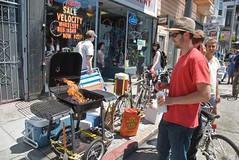
The route through NOPA will permit two-way travel on the selected streets and will be open to festivities from 10 am to 3 pm. Organizers will provide extensive advance notice to residents, businesses, and churches located on the affected blocks to help them prepare for the occasion.

The full list of dates and locations include:

March 14: Embarcadero

April 11: Along the Great Highway

April 18: Bayview

May 23: Bayview

June 20: Mission

July 11: Mission

August 22: Great Highway/Golden Gate Park

September 19: NEW: Western Addition

October 24: NEW Civic Center/Tenderloin


In addition to this ambitious expanded version of Sunday Streets, the mayor and SFMTA will launch a pilot project next year to bring car-free days in one or more neighborhoods, somewhat similar to the Sunday closure of JFK Drive in Golden Gate Park. Presumably, these "block party"-type events will not entail the rather steep application fees to close the block to car traffic.

BIKE NOPA will feature further news on Sunday Streets in the months ahead. Also check for information from these sites: Livable City, the SF Bicycle Coalition, Alamo Square Neighborhood Association, MTA, and NOPNA at www.nopna.org . BIKE NOPA first suggested including NOPA in the 2010 roster in this Oct. 6th post.

* For those new to Sunday Streets, the event is not envisioned as a giant street fair with vendors taking the place of parked vehicles. People enjoying the streets usually frequent nearby stores, restaurants, and cafes or find the curb a good spot to watch the passing scene.